All figures are on BNB Smart Chain (BSC) · as of 26 June 2026
Following the money on the blockchain
Aurum sells itself as AI bots that grow your money. We didn’t trust the pretty dashboard. We followed the real money on the blockchain instead. The result is clear: your deposit earns no real profit. It is just collected and pulled back out. More than half ends up with a small group of insiders (the people behind the system) using their own digital accounts (called wallets in crypto) that never paid in a single cent themselves. All of this is publicly verifiable on BscScan — a public ledger where anyone can look up every single money movement themselves.
In plain words
Picture Aurum like a savings account. You pay money in and watch “interest” grow. But that interest doesn’t come from any real business. It’s just the money of the next people who pay in after you. And more than half of all the money is taken by the operators themselves. As long as enough new people keep joining, it runs. Then the money is gone. That is exactly what a Ponzi scheme is.
⚠ The definitive proof
THE AI PROFITS ARE NOT REAL — WHAT GETS PAID OUT IS JUST OTHER PEOPLE’S MONEY
The system never earned the promised profits. It only hands around the money people pay in. And it skims off a big chunk. Here is the simple math. You can check every number yourself on BscScan.
- ✕ More money came in than was ever earned by trading. Around 9,900 people paid in $83.5M. Of that, $77.2M was paid back out — but be careful: more than half of it ($45.5M) went to the operators themselves, not to investors. Only $31.7M reached earlier users as “profit” — and that was just the next person’s deposit, not income from real trading. Net, participants paid in $51.8M more than they ever got back. That is exactly what a Ponzi scheme is. All verifiable on BscScan.
- ✕ The promised return doesn’t exist on the blockchain. Aurum promises 15 to 30% profit per month. If that were real, the system’s cash box would have to hold far MORE money than was paid in — namely the profit on top. Instead, only $119k is left. The promised profit never existed, just like interest on an empty savings book. Verifiable on BscScan.
- ✕ More than half of the money paid out went to people who never paid in anything themselves. Exactly $45.5M — that is 54% — went to just 23 digital accounts (wallets) that never paid in a single cent. These are presumably the operators. Verifiable on BscScan.
- ✕ The AI trading is just a show. On the blockchain the system only parks your deposit in one single place (a kind of pooled account on the crypto platform PancakeSwap). So it is parked, not traded. Two privileged accounts (named “Admin” and “Operator” in the system — that is administrator and operator) pull the money back out. Your growing bot profit is just a number on the screen. Nothing more. Verifiable on BscScan.
The recycling, day by day
If this were real trading, the payouts would come from profits. They would have nothing to do with today’s deposits. But in truth the two are closely linked. On every single day, the money paid out is almost exactly as much as the money newly paid in that same day. So the system simply hands the fresh deposits straight back out.
| Date | Deposits IN | Paid OUT | Out ÷ in |
|---|---|---|---|
| 2026-06-13 | $1.57M | $1.53M | 98% |
| 2026-06-14 | $2.46M | $1.99M | 81% |
| 2026-06-15 | $1.92M | $1.65M | 86% |
| 2026-06-16 | $2.22M | $1.62M | 73% |
| 2026-06-17 | $1.57M | $1.69M | 108% |
| 2026-06-18 | $1.45M | $1.68M | 116% |
| 2026-06-19 | $2.28M | $1.81M | 79% |
| 2026-06-20 | $2.23M | $1.76M | 79% |
| 2026-06-21 | $2.52M | $2.28M | 91% |
| 2026-06-22 | $2.00M | $1.82M | 91% |
| 2026-06-23 | $1.77M | $1.87M | 106% |
| 2026-06-24 | $2.10M | $3.09M | 147% |
| 2026-06-25 | $1.62M | $2.04M | 126% |
| 2026-06-26 | $1.49M | $1.39M | 93% |
On several of the last few days, even MORE money went out than came in (June 24: 147%, June 25: 126%). The system is now reaching into its nearly empty cash box just to keep paying. This is the final stage of a Ponzi scheme. (Source: on-chain deposit and withdrawal events on BNB Smart Chain, verifiable on BscScan.)
The proof it isn’t “trading”
Of all the money paid out, about 54% — that is $45.5M — went to just 23 digital accounts (wallets) that never paid in even a single dollar. One of them alone received $31.2M. A real investment pays money back to its investors. Here, more than half went to insiders who only pulled money out and never paid anything in. All public on BscScan.
Where the $83.5M actually went
| Paid in by ~9,900 participants | + $83.5M |
| Out → insider wallets (the operators) | − $45.5M |
| Out → recycled to earlier users as “ROI” (paid out of newer deposits) | − $31.7M |
| Still sitting in the treasury — everything that is left | $119k |
The bottom line: participants paid in about $51.8M more than they ever got back. Of that, the operator accounts have already taken $45.5M. The system’s cash box has only $119k left. And still, around $1.7M keeps flowing in every day. All verifiable on BscScan.
How it actually works
1. You pay in
You send your money (USDT or USDC) to the system’s cash box. In the app you then see a number that climbs every day. But that is only a display. It is like the balance on a savings book with no real business behind it.
2. The money gets pooled
All deposits are pooled and parked in one place (a kind of pooled account on the crypto platform PancakeSwap). That looks like modern investing. In truth the money stays under the operators’ control the entire time.
3. The insiders take the money
Two privileged accounts pull the money back out. The largest of them received $31.2M on its own. These accounts never paid in anything themselves. They only collect.
4. Early users get “profit”
Part of it goes back to earlier users as “return”: $31.7M. But this money does not come from trading. It comes from the deposits of the newer people. That is exactly how a Ponzi scheme works.
The key addresses
Click any address to verify it yourself on BscScan.
USDT treasury (deposits land here)
0xE197f1229f7625D74780F1F6Be2B9552566FA1e0 ↗The Neyro deposit contract for USDT.
Admin wallet (can withdraw)
0x89469499976BE5d58f78b970E5951870f6657EA7 ↗Holds the contract’s DEFAULT_ADMIN role; submits the withdrawals. 132,999 transactions.
Operator wallet
0x8B45CdA448cC26e7F55Ef3E77374c7CAE8199b61 ↗Holds the OPERATOR role; typical recipient of the “collected” funds.
Wallets that took money without ever depositing
| 0x42c8d37f…2a5f61 ↗ | $31,188,051 |
| 0xd3d2bc1d…22f367 ↗ | $2,121,000 |
| 0x28397b8b…4180d0 ↗ | $2,020,000 |
| 0x5d94caa2…60ec02 ↗ | $1,010,000 |
| 0x12997357…10bd6b ↗ | $1,010,000 |
Top 5 of 23 such wallets. Together the 23 received $45.5M without ever depositing.
The money trail — full map
We followed the operators’ money step by step, out of the system’s cash box. Imagine it went to an exchange to actually trade. It does not. Instead it is run through a web of many digital accounts, one stage after another. Every account is verifiable on BscScan.
~9,900 depositors  ──$83.5M──▶  NEYRO TREASURY  (BNB Smart Chain)
                                  ├─ USDT  0xE197…1e0
                                  └─ USDC  0x27E4…84a6
                                       │  collected / withdrawn by
                                       ├─ ADMIN     0x8946…7EA7   (132,999 tx)
                                       └─ OPERATOR  0x8B45…9b61   ( 99,127 tx)
                                            │
                                            ▼   $45.5M  →  23 wallets that NEVER deposited
        ┌───────────────────────────────────┴──────────────────────┐
        ▼                                                           ▼
  0x42c8…f61   +$31.2M  (top insider)              22 more insider wallets   +$14.3M
        │
        ├─ $23.6M ─▶  0xb16c…0400   high-volume hub (14,000+ tx)
        │                  └─ fans out to ~2,000 mostly-fresh wallets   ◀ layering
        ├─ $7.6M  ─▶  dispersed across 830 addresses
        └─ $1.5M  ─▶  0xa02c…8365  ─▶  $5.67M  ─▶  contract 0x233c…b4cd
The biggest insider — its digital account carries the number 0x42c8 — received $31.2M. That number is simply the name of the account, which anyone can look up on BscScan. From that, it passed $23.6M on to a collection hub (the account with the number 0xb16c). From there the money was split across roughly 2,000 fresh accounts — broken up into many small accounts to blur the trail. Nowhere in this trail does a trading exchange appear. This is a typical pattern for hiding money. Where the money finally ends up is presumably deliberately concealed. All verifiable on BscScan.
The traced addresses — leads for investigators
Top insider wallet: received $31.2M, forwarded $23.6M onward and dispersed the rest — a distribution hub.
High-volume hub (14,000+ tx) that received $23.6M and fans it out to ~2,000 mostly-fresh wallets — layering.
Secondary branch that consolidated ~$5.67M before forwarding it on.
Consolidation contract that received ~$5.67M.
How we uncovered this
The trail from a single invitation to the operators’ wallets — and how you can retrace every step yourself.
1. It started with the invitation
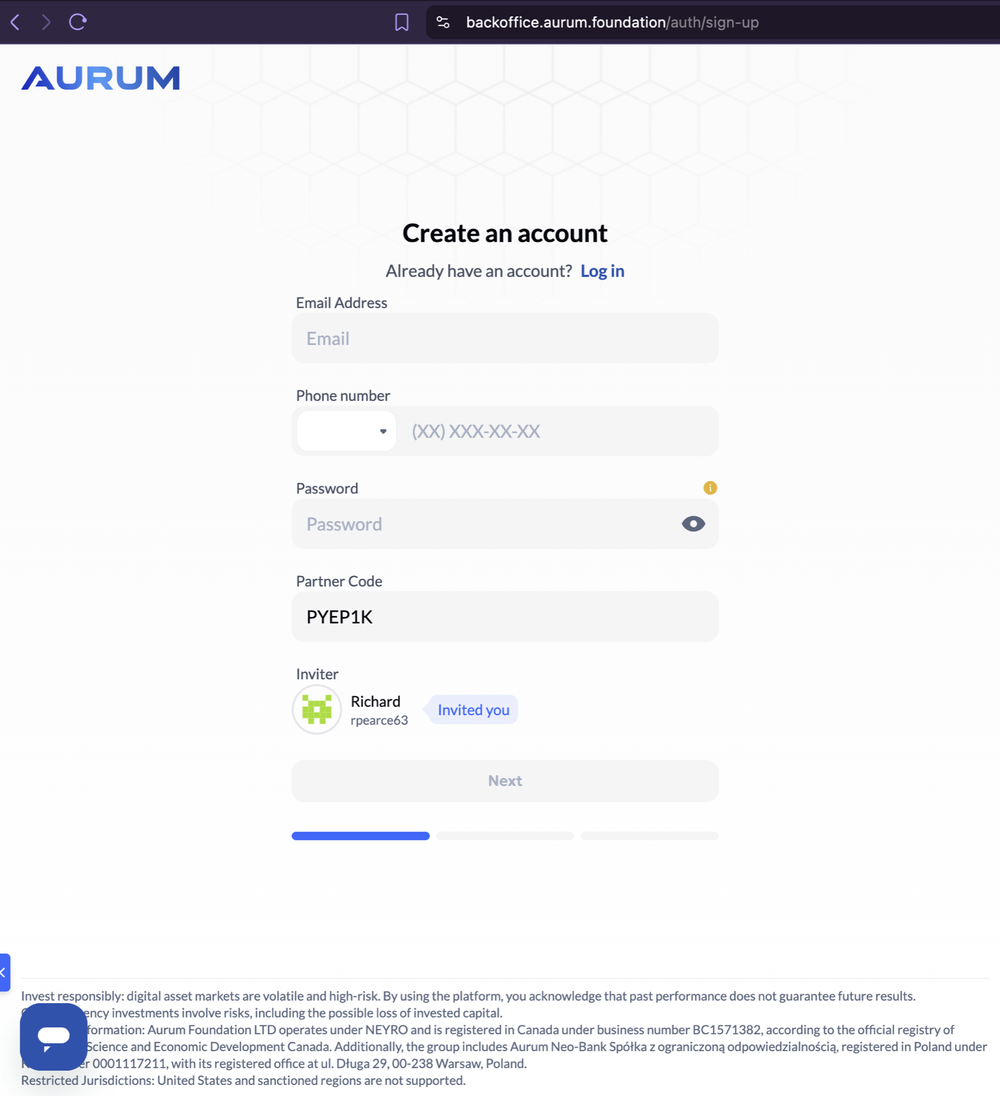
Aurum is invite-only: registration requires a partner code. The code used to get in traces to an affiliate shown as the inviter on the sign-up screen — handle “rpearce63”, partner code PYEP1K.
2. The inviter openly promotes Aurum
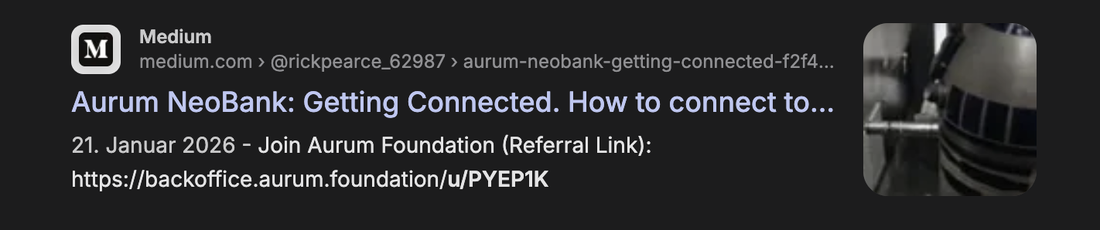
The same person publishes promotional articles on Medium with his Aurum referral link — for example “Aurum NeoBank: Getting Connected” and “Aurum Deep Dive: 17.5% Monthly Returns” — writing “you can join me using the following link.”
3. He published an on-chain tool on GitHub
On his public GitHub account he published “neyro-analysis”, a dashboard that indexes the Neyro contract on BNB Smart Chain. Its source file lib/contracts.ts names the exact treasury, admin and operator addresses, and the tool computes which recipients took money without ever depositing. This is what pointed us at the right contracts.
4. How the wallets were verified — and how you can too
We did not take any of it on trust. We read the contract addresses from the public repo, then independently re-checked every one against the blockchain using public RPC nodes and BscScan: the treasury’s balance, the admin/operator role-holders, and the deposit-versus-withdrawal totals. Crucially, none of this requires insider access — a contract’s roles are publicly readable, and the “non-depositor” wallets are simply computed from public deposit and withdrawal events. Anyone can reproduce it: open any address above on BscScan and add up the flows yourself.
The analytics dashboard that first surfaced these flows was built and published by an Aurum promoter — see Who’s behind it →
Plain-language glossary
- Smart contract / “treasury”
- A program on the blockchain that receives and holds money. Here it is the wallet your deposit is sent to.
- “Collect” event
- When the operators pull money out of the pooled liquidity. Each one is a permanent, timestamped record on the chain.
- Non-depositor
- A wallet that received money from the contract but never sent any in — i.e. it only takes out. Strong signal of an insider.
- BscScan
- The public block explorer for BNB Smart Chain. Anyone can search an address and see every transaction.
- Insolvent
- Owing more than you can pay. Even by its own books the contract holds only ~$119k against ~$6.2M of claimed balances. The real damage is far larger: participants are ~$51.8M out of pocket and $45.5M was taken by insiders.